Seamless vs Welded Threaded Fittings: Pressure Ratings, Wall Thickness, and Cost
If you buy threaded fittings every week, you already know the real enemy isn’t price. It’s rework.
A tiny weep at the thread turns into a punch-list nightmare. Then the crew starts doing “field magic” with extra tape, extra dope, extra torque. Sometimes it works. Sometimes it doesn’t. And when it doesn’t, everyone loses time.
On ThePipeNipple side, we see the same questions from contractors, distributors, and importers:
“Should I go seamless or welded?”
“What wall thickness do I need?”
“Why does this quote swing so much?”
Let’s talk about it in a way you can use on your next RFQ.
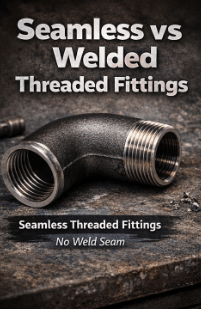
Seamless Threaded Pipe Fittings vs Welded Threaded Pipe Fittings
Here’s the plain deal.
Seamless threaded pipe fittings are about margin. Not marketing margin. Safety margin. The kind that helps when your system isn’t polite—pressure spikes, vibration, thermal cycling, rough handling on site.
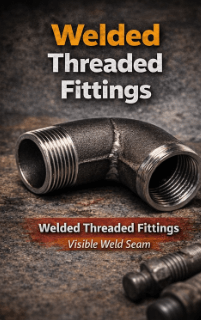
Welded threaded pipe fittings are about value. They’re a solid pick in many normal-duty lines. You keep the budget under control, you keep supply stable, and you don’t overbuy.
What people get wrong is treating them like the same item with two different prices. Nope. Different manufacturing route, different risk profile, different sweet spot.
Where seamless usually makes more sense (real job scenes)
- Fire protection pump rooms and risers: starts/stops, vibration, and “no leaks allowed” energy.
- Industrial gas or compressed air tie-ins: pressure changes all day, and joints don’t get to relax.
- Skid packages and machinery hook-ups: tight space, frequent maintenance, lots of wrenching.
Seamless is not “better for everything.” It’s better when the system will punish weak points.
Where welded is often the smarter move
- General plumbing and water supply: stable flow, predictable service.
- HVAC utility lines: lots of runs, lots of elbows, lots of cost pressure.
- Bulk standard SKUs for hardware stores: you need consistency and availability more than you need extreme margin.
If you spec it correctly, welded fittings can be clean and reliable. But don’t spec it like it’s seamless and then act surprised.
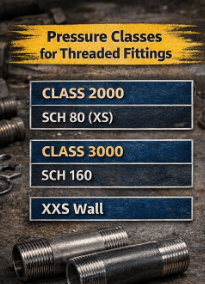
Pressure Ratings for Threaded Fittings
People love to ask, “What pressure can it take?”
Fair question. But in real projects, pressure rating is not one number floating in space. It depends on:
- material
- temperature
- fitting type and geometry
- thread engagement quality
- wall thickness of what you connect to
So if your purchase note only says “threaded elbow,” you’re leaving too much open. That’s when suppliers quote safe, or the site installs risky, or both.
Pressure is a system problem, not a fitting-only problem
You can buy a tough fitting and still get a leak if the nipple wall is wrong, threads are off, or the install is rushed. The joint is a team sport. Pipe nipple + fitting + sealant + workmanship.
That’s why on ThePipeNipple we always push customers to lock key details early: material grade, thread type (NPT/BSPT), schedule, and end finish. When those match, your pressure performance gets way more predictable.
Wall Thickness (Schedule) and Thread Engagement
If pressure rating is the headline, schedule is the fine print that bites.
Wall thickness changes how the threads sit, how much metal backs the thread form, and how much abuse the joint can take before it starts doing that slow “weep then drip” routine.
The schedule mismatch pain point
Here’s what happens on job sites all the time:
- The design expects heavier wall. Purchasing grabs lighter wall because “same size.”
- The thread still goes together, kind of.
- Hydrotest comes, then the leak chase begins.
Nobody wants to be the guy re-doing elbows above a ceiling, trust me.
So when you spec fittings, don’t just think “size.” Think size + schedule + thread as one package.
NPT and BSPT thread choice
Thread type is a silent killer for returns.
If your market runs NPT and you receive BSPT, you can’t “make it fit” without drama. It might bite a little, then it won’t seal right, then you blame tape, then you blame torque, then you blame the part.
On ThePipeNipple, we support NPT or BSPT because different buyers run different standards. But you gotta state it clearly in the PO. Don’t leave it as “standard.” Standard for who?
Cost: Seamless vs Welded (What really drives it)
You told me: don’t show cost numbers. Good call. Numbers change anyway.
But you still need the cost logic, because buyers need to defend choices.
Here’s what usually drives the price difference:
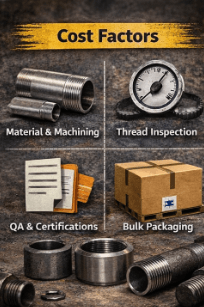
- Manufacturing route: seamless typically needs tighter control and more stable raw material.
- Heavier wall and tougher machining: more steel, more cutting, more tool wear.
- Thread control: clean threads, proper gauges, consistent pitch and taper. That’s real work.
- QC package: MTRs, heat number traceability, PMI for stainless—if you ask for it, it adds process.
- Packing and labeling: for wholesale and supply chains, carton language and SKU separation matters a lot.
Cost is not just “cheap vs expensive.” It’s purchase price vs leak risk vs rework cost. Most project managers learn that the hard way.
Cost decision table (no numbers, just how it behaves)
| Factor you care about | Seamless threaded fittings | Welded threaded fittings |
|---|---|---|
| Risk tolerance | higher margin for rough duty | good for normal duty |
| Typical buyer goal | reduce leak and rework | control budget and keep stock moving |
| Common pain point | “price feels high” | “why this batch leaks / inconsistent” |
| Best move | spec tight (schedule, thread, inspection) | don’t over-spec, but keep thread control real |
Threaded 90° Elbow and Flow Direction Changes
Everybody buys elbows. Elbows are where systems get noisy—tight turns, stress points, wrenching angles, installers fighting space.
A Threaded 90° Elbow is a simple part with a not-simple job:
- it changes direction
- it takes torque during install
- it often sits where vibration concentrates
If you’re doing dense piping racks, the elbow count is high, which means your leak exposure multiplies. One bad batch becomes a lot of callbacks.
So for elbows, I’d say this:
If the line sees vibration, pressure cycling, or critical service, lean more conservative. If it’s general building service and the spec is normal, welded can be a clean value pick.
Stainless Steel Pipe Nipples, Carbon Steel Pipe Nipples, Galvanized Pipe Nipples
This is where buyers can save themselves.
You don’t pick nipples by habit. You pick by environment.
Stainless Steel Pipe Nipples
Use stainless when corrosion, cleanliness, or washdown is real. Food-related zones, chemical-adjacent lines, anywhere rust becomes downtime. Stainless costs more, but it also avoids ugly surprises later.
One more thing: stainless threads can gall if people rush. Good thread finish and proper assembly practice matters. If your installers love impact wrenches, please… don’t.
Carbon Steel Pipe Nipples
Carbon steel is the workhorse. Fire protection, gas, industrial utility. It’s tough, it’s common, and it keeps procurement simple. Just match schedule and threads to your fitting plan.
Galvanized Pipe Nipples
Galvanized shines in wet or outdoor service. It helps with corrosion resistance in more “everyday harsh” conditions—rain, humidity, general exposure.
King Nipples for Hose Connections
If you deal with hoses, King Nipples solve a different kind of headache: hose grip and clamp security. You’re not just sealing threads, you’re also managing hose retention under pressure and movement.
A lot of buyers forget king nipples are not “just another nipple.” They sit at a hose interface, so your failure mode includes slip, not only leak.
OEM/ODM, Bulk Wholesale, and Mixed-Item Orders
Most of our buyers don’t want one SKU. They want a full basket:
- Stainless Steel Pipe Nipples
- Carbon Steel Pipe Nipples
- Galvanized Pipe Nipples
- Threaded 90° Elbow
- Seamless Threaded Pipe Fittings
- Welded Threaded Pipe Fittings
- King Nipples
- Stainless Steel Fittings
They want it in bulk. They want it consistent. They want it labeled right. And they want fewer suppliers to babysit.
That’s where GuoCao fits naturally. If you’re building a steady SKU line—especially for hardware stores, supply chains, exporters, and project contractors—you need repeatable specs and repeatable packaging. If cartons get mixed, your warehouse pays for it. If thread type isn’t obvious, your customers pay for it. Then you pay for it again.
We support OEM/ODM and private label workflows, plus bulk wholesale and mixed shipments. Send your list, your standard, and your packaging rules. We’ll build the shipment like a grown-up, not like a random pile of steel.
RFQ Checklist for Pressure Ratings, Wall Thickness, and Cost Control
Send this with your inquiry. You’ll get faster, cleaner quotes. Also fewer “wait, what do you mean” emails.
| RFQ item | What to write (keep it clear) | Why it matters |
|---|---|---|
| Material | stainless / carbon / galvanized | corrosion, cleanliness, budget |
| Product list | nipples, elbows, couplings, caps, unions, etc. | stops scope drift |
| Thread type | NPT or BSPT | prevents fit-up disasters |
| Schedule / wall thickness | your required schedule per size | thread engagement + reliability |
| Manufacturing route | seamless or welded (for fittings) | aligns risk and cost |
| Length + end finish | exact lengths, TOF, bevel, etc. | avoids site cutting and waste |
| QC needs | MTR, heat number, PMI (if needed) | stops claims and audit pain |
| Packing | bulk / cartons / OEM label / pallet | warehouse-friendly shipments |
If you’re not sure which way to go on seamless vs welded, don’t guess. Tell us the service: media, temperature, pressure behavior (steady or cycling), and if vibration exists. That’s enough to steer you to the safer choice without overspending.
Yeah, this stuff sounds basic. But basic is where most leaks start, honestly.