
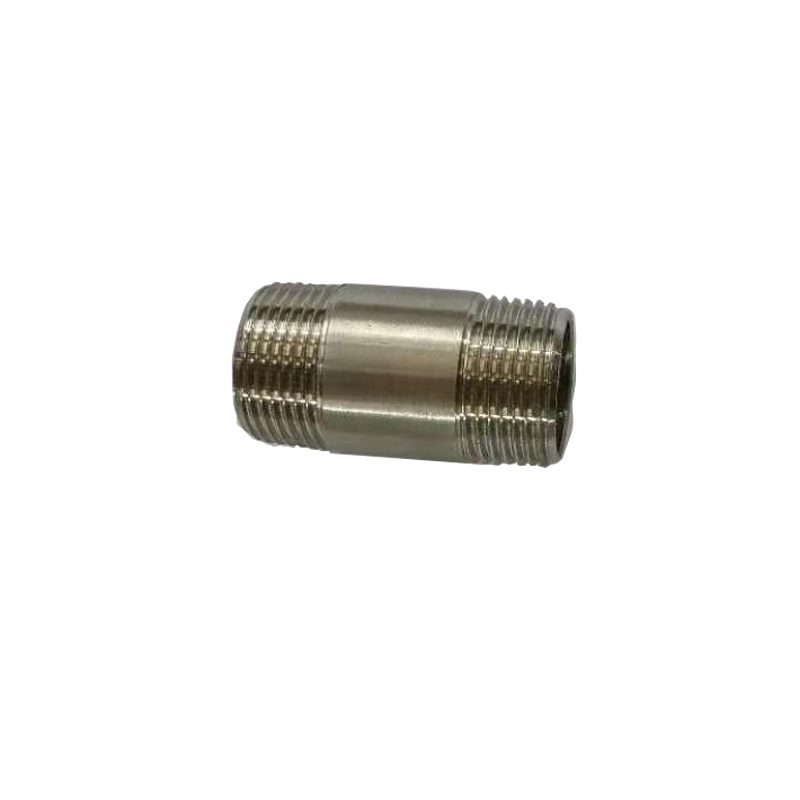
If you run a water treatment line, you don’t really care about “metal vs metal.” You care about call-backs, leaks at threaded joints, brown water complaints, unplanned shutdown, and that painful moment when the plant manager asks: “Why are we fixing this again?”
So let’s talk straight: galvanized fittings can survive in some water service, but in a lot of treatment-duty scenarios, stainless steel lasts longer and behaves more predictably—especially once flow, disinfectant, deposits, and mixed metals show up.
Below I’ll lay out the key arguments (with real data), then tie it back to buying decisions for wholesalers, contractors, and OEM skids—plus where Stainless Steel Pipe Nipples fit in cleanly for your BOM.
Galvanized steel vs stainless steel lifespan data in water environments
The cleanest “apples to apples” lifespan numbers I found come from a published comparative study that estimated service life under different salinity and flow velocity conditions. It’s not literally “every water plant on earth,” but it does show the pattern you see in the field: galvanized life drops fast when conditions get aggressive, while stainless holds on much longer.
Lifespan comparison table (galvanized vs SS304)
| Condition (from published test model) | Galvanized steel estimated lifespan | SS304 estimated lifespan | What it means in plain English |
|---|---|---|---|
| Salinity 3% (no flow velocity noted) | 11.799 years | 76.923 years | In more corrosive water, stainless can outlast galvanized by a lot |
| Salinity 6% (no flow velocity noted) | 2.954 years | 61.224 years | Galvanized gets chewed up way faster as salinity rises |
| Salinity 3% + flow velocity 3.45 m/s | 7.092 years | 71.428 years | Higher velocity shortens life; galvanized feels it harder |
| Salinity 3% + flow velocity 6.83 m/s | 5.571 years | 65.217 years | Fast flow = more punishment, less forgiveness |
Source: published lifespan estimation study.
No, you shouldn’t copy-paste these as “guaranteed years” for every project. But you can use them as a strong technical backbone to argue this: stainless steel generally gives you a wider safety margin when water chemistry and hydraulics aren’t gentle.
Zinc coating corrosion in galvanized fittings
Galvanized parts protect carbon steel by using a zinc coating. In real-life water service, that zinc is basically a “wear layer.” Once it’s consumed or damaged, the base steel starts corroding faster, and the inside surface gets rough. That roughness grabs scale and debris like Velcro, then you get restriction, pressure drop, and ugly water quality surprises.
pH range 5.5–12 for galvanized steel performance in water
Galvanized performance is strongly tied to water chemistry. A practical way to say it: it behaves “more stable” in a mid pH band and becomes riskier at extremes. That’s why galvanized can look fine in one site and fail early in another site that “looks similar” on paper.
Here’s the punchline for water treatment duty: your water isn’t always stable. Plants swing pH in dosing steps, you’ve got chemical cleaning, backwash cycles, and sections that sit wet. That’s where galvanized gets moody.
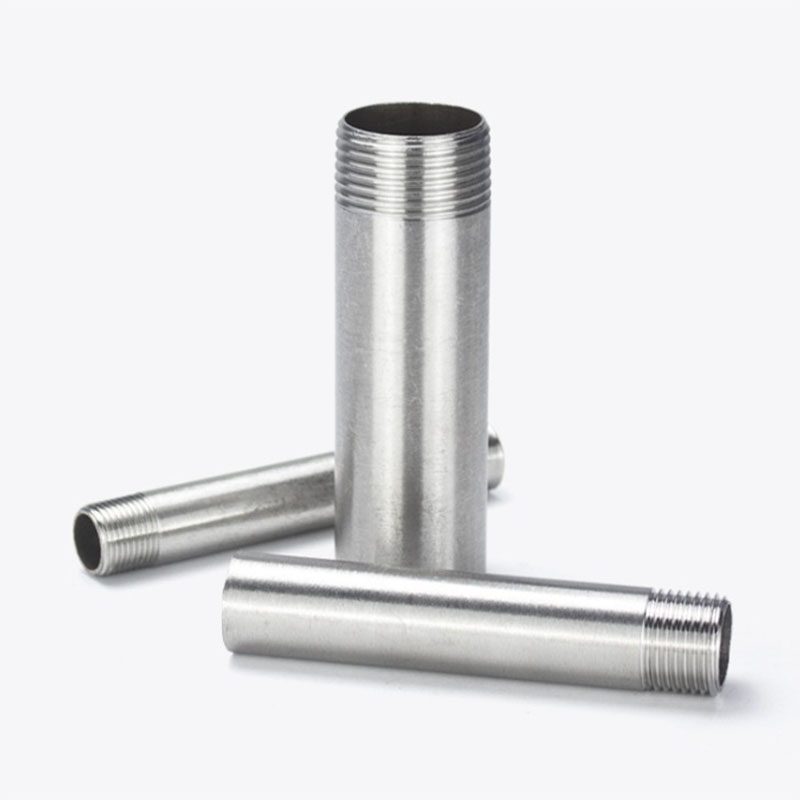
Flow velocity and erosion-corrosion in water treatment piping
In treatment systems, velocity isn’t a detail. It’s the whole game. You’ve got:
- high velocity sections on filter feeds
- recirculation lines on process skids
- intermittent surges on backwash
- pump starts/stops that slam fittings
When velocity climbs, you increase mass transfer and surface wear effects. The same lifespan study showed both materials drop with velocity, but galvanized drops harder.
If you’ve ever had a fitting that “looked okay” on the outside but was nasty inside, you’ve seen this movie already.
Residual chlorine 3–5 mg/L and crevice corrosion risk for 304L
A lot of folks hear “stainless” and assume it’s magic. It’s not. Stainless can still lose if you pick the wrong grade for the chemistry.
One key point from a water-treatment-focused stainless guide: in the 3–5 mg/L residual chlorine range, Type 304L becomes vulnerable to crevice corrosion, while 316L is expected to be more resistant in that same chlorine range.
That matters because crevice corrosion loves the exact stuff you have in treatment plants:
- threaded connections
- gaskets and dead zones
- deposits sitting on the metal
- low-flow corners
So the “pro” advice isn’t just “use stainless.” It’s: use the right stainless for the water and the joint geometry.
Galvanic corrosion between stainless steel and galvanized carbon steel
Here’s a nasty trap: you upgrade 80% of the line to stainless, then someone tosses in a galvanized nipple “because it’s in stock.” Now you’ve got dissimilar metals in an electrolyte (water). That’s a recipe for galvanic corrosion, where the less noble metal corrodes faster under the right conditions.
In water-industry service, stainless is relatively noble. Galvanized zinc/carbon steel is less noble. When you connect them wrong, the weak link often isn’t “somewhere random.” It’s right at the mixed-metal connection, exactly where you don’t want a leak.
This is why experienced buyers push for consistent material specs on nipples, elbows, and threaded fittings. It reduces “mystery failures” and saves your maintenance team from chasing ghosts.
Drinking water plumbing facts: corrosion and trace lead in galvanized layers
If the system touches potable water, the conversation shifts. It’s not only about service life. It’s also about water quality risk.
An EPA plumbing factsheet notes that galvanized steel pipes corrode easily and that galvanized zinc layers may have traces of lead, plus internal corrosion can contribute to contamination concerns.
For water treatment contractors and distributors, this supports a professional stance: stainless steel fittings can reduce regulatory and reputational headaches in sensitive potable scenarios. You don’t want your project remembered as “that install with the weird metal taste complaints.”
Practical decision matrix: where galvanized still makes sense vs where stainless wins
Let’s be real. Galvanized isn’t useless. It’s a tool. But don’t use a hammer on a screw.
Quick selection table for water treatment duty
| Keyword condition | Galvanized fittings | Stainless fittings | Why buyers pick it |
|---|---|---|---|
| Mild water, stable chemistry, low velocity, non-critical service | Can be acceptable | Also works | Budget-driven, short cycle projects, low risk |
| Disinfectant present (residual chlorine), deposit-prone zones | Risk goes up | Usually preferred (often 316L > 304/304L) | Stainless handles “messy reality” better |
| Mixed metals in the same run | Dangerous unless isolated | Manageable with correct design | Prevent galvanic trouble, fewer leaks |
| Tight QA, potable water concerns | Not ideal | Strong choice | Lower contamination concerns |
| Skid packages / OEM systems needing repeatability | Variability hurts | Better consistency | Cleaner submittals, fewer warranty returns |
Threaded pipe nipples in treatment systems: why the “small parts” cause big downtime
Most leaks don’t start in the middle of a straight pipe. They start at the joints. And in treatment plants, threaded nipples are everywhere:
- sampling loops
- pump suction/discharge accessories
- instrument tees
- chemical dosing manifolds
- RO/UF skid hook-ups
- maintenance bypass lines
A nipple is cheap until it causes a shutdown. Then it becomes the most expensive part of your week.
That’s why Stainless Steel Pipe Nipples are a high-impact category for wholesalers, export buyers, and OEM/ODM customers. You get:
- more stable corrosion behavior
- cleaner inside surface over time
- fewer surprises at the threads (with correct finish and thread control)
And yes, you still need good basics: correct NPT thread engagement, proper sealant selection, avoiding over-torque, and not mixing random metals like it’s a salad bar.
Real-world scenarios (no fake names, just stuff that happens)
Scenario: RO skid with intermittent flush and chemical cleaning
RO skids see flushing, sometimes low-flow idle periods, and occasional chemical cleaning. Those are classic “crevice + deposit + chemistry swing” conditions. Galvanized threaded parts can end up with uneven corrosion, then you get weeping at the joint. Stainless tends to be a safer bet, and in more aggressive disinfectant conditions, 316L usually gives more breathing room than 304L.
Scenario: Filter backwash line with higher velocity
Backwash can spike velocity. Even if the average flow is modest, the peaks matter. The lifespan study data shows life dropping as velocity rises, especially for galvanized. You don’t want to learn that the hard way during commissioning.
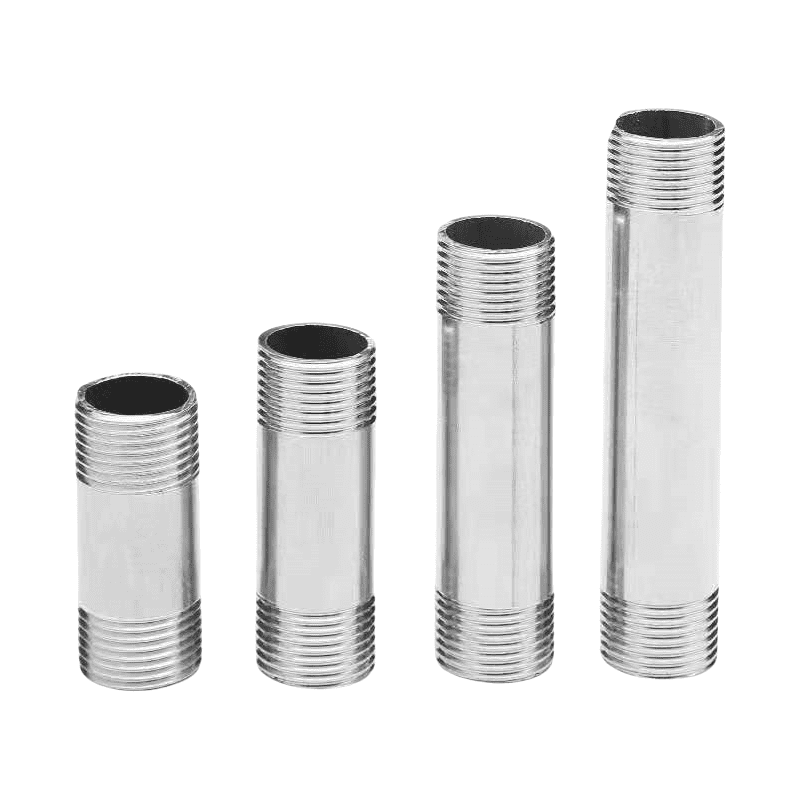
Scenario: “partial upgrade” retrofit
Plants love phased retrofits. They’ll replace a section this year and another next year. If you end up with stainless connected to galvanized without isolation planning, galvanic corrosion risk climbs. This is the classic source of “why is the new section fine but the connection keeps failing?”
Where GuoCao fits, without the salesy cringe
If you’re buying for construction companies, industrial machinery makers, hardware chains, or export wholesale, you don’t just want parts. You want fewer problems:
- fewer reworks on site
- smoother inspection/submittals
- stable lead time for bulk lots
- OEM/ODM flexibility for private label or custom spec
- consistent threading so installers don’t curse your brand
That’s the lane where GuoCao shows real value. Not with hype words, but with boring stuff that makes money: tight QC on threads, stable material traceability, and custom/bulk capability for stainless nipples and threaded fittings.
And if your product list already covers Stainless Steel Pipe Nipples, 90° elbows, black steel nipples, galvanized nipples, king nipples, seamless/welded threaded fittings, then the smart play is aligning your material choices to the service risk. Stainless nipples in treatment-duty zones reduce headaches. Galvanized can stay for less critical utility lines where the spec allows it.
Buying tips for wholesalers and OEM/ODM projects
- Lock the grade early: 304/304L is common; if chlorine is higher or crevices/deposits are likely, consider 316L.
- Avoid mixed-metal patchwork: if you must mix, design it intentionally, don’t “field improvise.”
- Ask for consistency: same thread standard, same passivation/pickling approach when needed, same inspection method lot-to-lot.
- Think in downtime, not unit price: one leak can burn a whole day of labor and reputation. I’m not even kidding.
Wrap-up: the clean argument you can use in proposals
Galvanized fittings can last “okay” in mild water service, but their lifespan swings a lot with chemistry and operating conditions. Stainless steel generally lasts longer and behaves more consistently in water treatment systems, especially when velocity, disinfectant, deposits, or mixed metals come into play. Real published estimates show big life gaps under aggressive conditions. And if the system is potable-related, corrosion and trace metal concerns make stainless even easier to justify.
If you want, I can also rewrite this into a tighter SEO post that targets your site title/description tone and keeps the keyword focus on Stainless Steel Pipe Nipples (plus elbows and threaded fittings) while staying natural.