
How to Choose the Right Pipe Nipple for Your Application
You’re not just buying “a small piece of pipe.”
You’re buying a leak point… or a quiet joint that never shows up on your punch list.
Pipe nipples look boring. But they sit right where pressure, temperature, vibration and mis-alignment all meet. When this little part fails, the whole line feels it.
A pipe nipple is a short piece of pipe with male threads on one or both ends. You use it to connect fittings, valves, equipment or instruments. At Jingcheng Hardware and the GuoCao team behind thepipenipple.com, we live in this world every day: Stainless Steel Pipe Nipples, Carbon Steel Pipe Nipples, Black/Galvanized Pipe Nipples, Seamless Threaded Pipe Fittings, Welded Threaded Pipe Fittings, 90° Elbows, King Nipples and more.
Let’s walk through how to pick the right nipple for your scene, not just for the catalog photo.
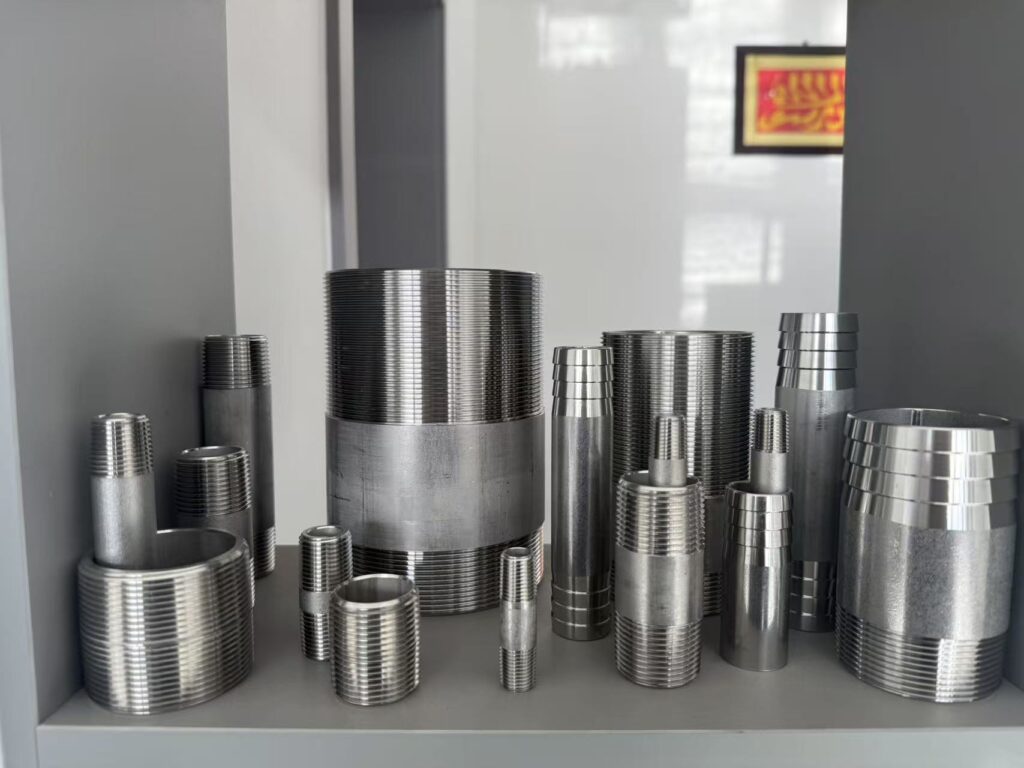
Pipe Nipple in Piping Systems: What Really Matters First
Before you ask for a price, ask yourself three simple things:
- What’s flowing inside this line?
- How hot or how cold does it run?
- How much pressure and shock does it see?
Medium, temperature and pressure decide:
- Material (stainless, carbon, galvanized)
- Schedule (wall thickness – Sch 40 / Sch 80)
- Type (seamless or welded, close or long, reducer or hex)
If you skip this and just say “½” NPT, looks ok,” you build a weak point.
That’s where water hammer hits first. That’s where steam eats the threads. That’s where gas sneaks out.
Think of the nipple as the “fuse” in your joint. Size it and choose it like you actually expect the line to work for years, not just pass the first pressure test.
Pipe Nipple Material Selection for Different Industrial Applications
Now let’s talk material. The wrong grade is why a lot of joints rust, pit, or get replaced at every shutdown.
Stainless Steel Pipe Nipples for Corrosive and Hygienic Service
Stainless Steel Pipe Nipples (304, 316, 316L) are your go-to when you fight corrosion or need clean surfaces.
Typical use scenes:
- Food and beverage skids
- Pharma and CIP/SIP circuits
- Desal and coastal plants
- Pool systems and chlorinated water
- Lines with frequent wash-down
Quick rule:
- 304 – general water, HVAC, many industrial fluids
- 316 / 316L – more chloride, more chemical, more peace of mind
One thing to watch: stainless threads like to gall. Use decent sealant, dont over-torque, and give the threads a chance to bite instead of fighting them with a long wrench.
Carbon Steel Pipe Nipples and Black Steel Pipe Nipples for Industrial Duty
Carbon Steel Pipe Nipples and Black Steel Pipe Nipples show up on almost every plant drawing.
Typical duty:
- Gas lines
- Boiler rooms and heater loops
- Dry sprinkler trunks
- Machinery frames, supports, “steelwork” around equipment
- General industrial utility lines
Why people still love carbon:
- Strong and rigid
- Weldable
- Friendly for bulk buys and big projects
Downside: bare carbon doesn’t like damp enviroment. If the line lives outdoors or in a wet pit, you either need coating, galvanizing, or you move to stainless.
Galvanized Pipe Nipples for Outdoor Utility Lines
Galvanized Pipe Nipples sit in the middle between raw carbon and full stainless.
You often see them on:
- Outdoor utility water
- Support lines around buildings
- Some low-temp wash lines
- Where there’s splash or rain but not hard chemicals
Zinc buys you some time against rust. But high temperature will age the coating, and any cut threads with no further protection expose bare steel. So galvanized is great for the right scene, not for every scene.
Material Selection Table for Pipe Nipples
You can use this as a quick mental map when you spec:
| Working scene | Medium & enviroment | Recommended pipe nipple material | Extra notes |
|---|---|---|---|
| Building HVAC loop | Clean water, mild temp | Carbon Steel or Galvanized, Sch 40 | Protect outdoor parts, follow local code. |
| Industrial gas train | Dry gas, indoor | Black Steel Pipe Nipples, Sch 40 or Sch 80 | For high pressure, prefer seamless. |
| Food / pharma skid | Clean media, CIP/SIP | Stainless Steel Pipe Nipples 304 / 316 | Often with 316L Seamless Threaded Fittings. |
| Coastal plant / desal | High chlorides, salt air | Stainless Steel Pipe Nipples 316 | Keep valves and fittings stainless too. |
| Outdoor water support | Rain, splash, not too hot | Galvanized Pipe Nipples | Seal cut threads, plan inspection cycles. |
If you start from this table before you call your supplier, your RFQ will already sound like you know the line, not just the size.
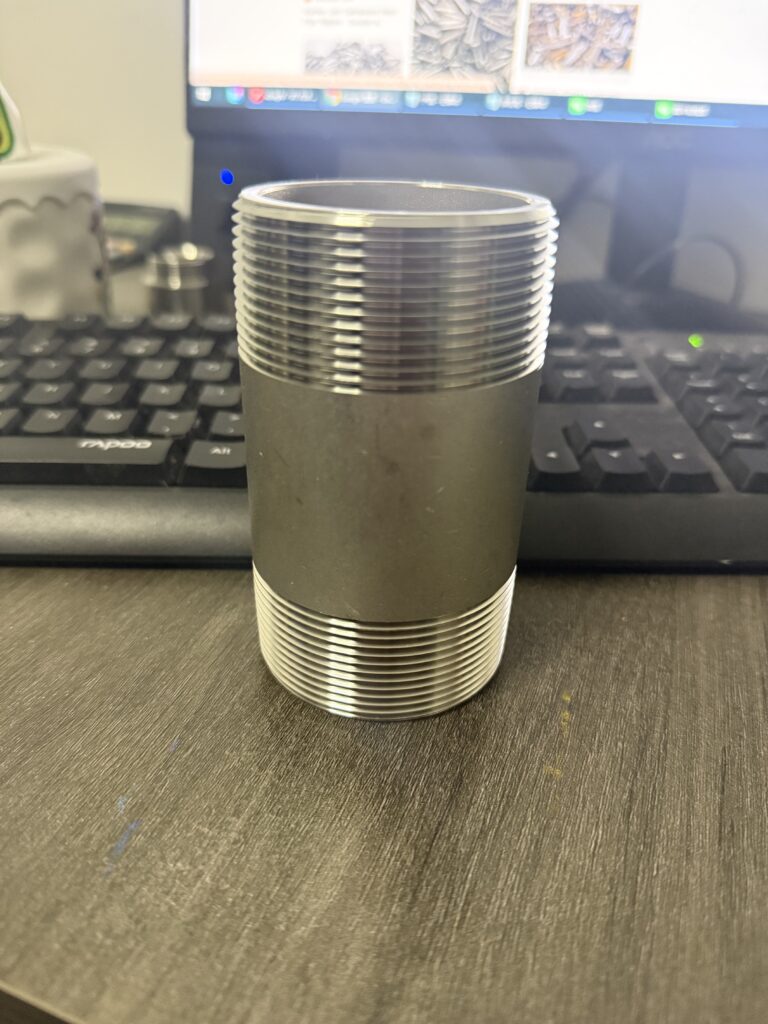
Pipe Nipple Size, Length and Schedule Rating
Once you’ve picked the material, you still need the right size, length and schedule. A nipple that’s too thin or too short will cause more rework than the whole flange set.
Nominal Pipe Size and Length for Pipe Nipples
Pipe nipples follow Nominal Pipe Size (NPS), same as your run pipe. That part is easy.
Length is where people mess up:
- Length is measured end-to-end, including threads
- You’ll see “close”, standard, long/extension and sometimes hex nipples
- Close nipples have almost no body, fully threaded
Close nipples help when you’re out of room, but they give no wrench land. The site team hates removing them later. Hex nipples and longer pieces are more friendly when you expect future maintenance, gauges, or valve swaps.
When you layout a skid or a riser, don’t just think “it fits in CAD.” Think “can a real person get a wrench on this without chewing up the threads.”
Schedule 40 vs Schedule 80 Pipe Nipples
Schedule is wall thickness. It must match the duty, not just the drawing.
- Schedule 40 – standard wall. Works for many water, HVAC and low-pressure gas lines.
- Schedule 80 – thicker wall. Better for high pressure, high temperature or rough handling.
Simple rule that saves you pain:
Don’t drop the nipple schedule below the pipe schedule.
If the main line is Sch 80, and someone sneaks in a Sch 40 nipple “because it’s in stock,” you already know where the first crack or leak will show when the line sees real pressure or water hammer.
Pipe Nipple Schedule Table
| Line type | Typical pressure / duty | Recommended nipple schedule | Comments |
|---|---|---|---|
| Standard HVAC / building water | Low to medium | Sch 40 | Welded or seamless both common. |
| Low-pressure air or nitrogen | Low | Sch 40 | Watch out for mechanical damage. |
| High-pressure steam | Higher pressure, high temp | Sch 80 seamless | No step down, no thin “fuse.” |
| Hot oil / thermal fluid | High temp, cyclic | Sch 80 seamless | Check material rating too. |
| Fire ring main | Code-driven, safety critical | Follow pipe schedule (40/80) | Don’t underspec the nipple. |
NPT vs BSP Threads on Pipe Nipples and Fittings
Thread type is the quiet trouble maker. On paper it looks fine. On site it becomes a drip.
The main families you’ll see on pipe nipples:
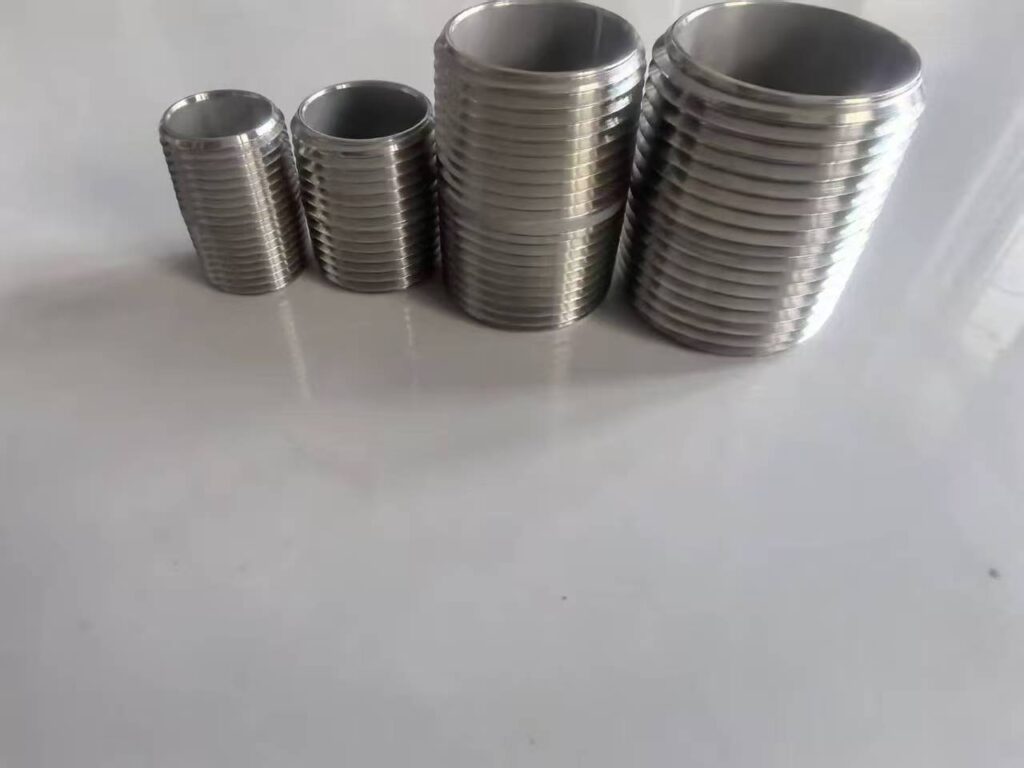
Thread Standards for Pipe Nipples (NPT, BSPT, BSPP, NPS)
| Thread standard | Region / common use | Angle & shape | Taper or straight | How it seals |
|---|---|---|---|---|
| NPT | North America, many global projects | 60° flank | Tapered | Metal-to-metal + sealant (tape or paste) |
| NPS | Some industrial systems | 60° | Straight | Needs gasket or seat, not self-sealing |
| BSPT | Europe, Asia, ISO / BS based plants | 55° flank, rounded | Tapered | Metal-to-metal + sealant |
| BSPP | Europe, equipment ports, manifolds | 55° | Straight | O-ring, gasket or machined face seal |
Fast visual checks:
- NPT/NPS threads look a bit sharper
- BSP threads look more rounded at crest and root
- Tapered threads “wedge” as you screw them in
- Straight threads just run down until they hit a shoulder or gasket
Please don’t mix NPT with BSPT “because it kind of screws in.” You might pass the first air test. After a few heat cycles and some vibration, it comes back as a mystery leak.
At GuoCao, we machine Stainless Steel Pipe Nipples, Carbon Steel Pipe Nipples and Welded Threaded Pipe Fittings in both NPT and BSP, so you can keep one standard per system instead of playing adapter Tetris.
Seamless Threaded Pipe Fittings vs Welded Threaded Pipe Fittings in Real Jobs
You see “Seamless Threaded Pipe Fittings” and “Welded Threaded Pipe Fittings” all over catalogs. They’re not the same tool.
Seamless Threaded Pipe Fittings and Nipples in High-Risk Duty
Seamless parts are rolled from seamless pipe, so there’s no longitudinal weld seam in the body.
You reach for seamless when:
- Pressure is high
- Temperature swings a lot
- Media is critical (steam, chemicals, expensive product)
- You expect a lot of start/stop and vibration
For these scenes, we often pair Seamless Threaded Pipe Fittings in 304, 316, 316L with matching stainless nipples. No weld in the flow path, more uniform wall, less worry about a seam being the weak point.
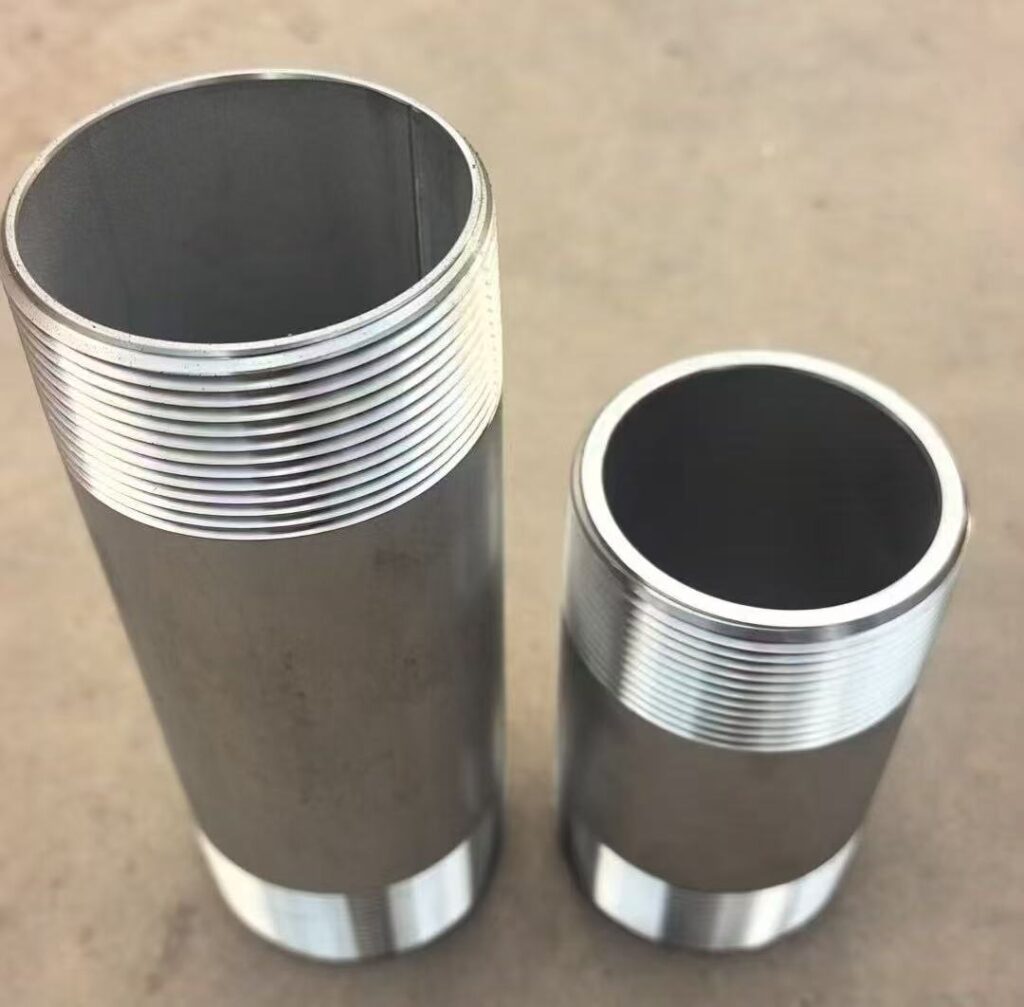
Welded Threaded Pipe Fittings and Nipples in Standard Service
Welded Threaded Pipe Fittings are made from welded pipe. For many water, air, and building service lines, they work perfectly fine and save budget.
Typical use:
- Building services and HVAC
- Utility water and air
- Manifolds where pressure is moderate and code allows welded
- Bulk jobs for Construction Companies and Hardware Stores
If your line is safety critical or you know it gets abused (like high-pressure steam), go seamless.
If it’s a normal utility or building service and the spec allows it, welded fittings and nipples are totally OK and more cost efficient for large orders.
Installation and Sealing Tips for Threaded Pipe Nipples
You can specify the perfect nipple and still get leaks if the make-up is bad. This is where site habits matter.
Here’s a simple workflow many installers use:
- Clean the threads
Remove chips, rust, oil, dirt. Dirty threads cut the sealant and cause scoring. - Choose the right sealant
PTFE tape, paste, or both. Make sure it matches your medium and temperature. Some chemicals attack common tapes or pastes. - Apply sealant the right way
Wrap tape in the direction you tighten, so it doesn’t bunch up. Two to three wraps is often enough. Too much tape can shed and clog downstream bits. - Tighten with feel
Hand tight first. Then wrench it to spec or to a known “feel” your crew trusts. Over-torque is why stainless galls and why threads crack. - Test before you hide it
Pressure test with water or air-under-water before you insulate, bury, or close the wall. Cheap test now saves ugly call-backs later.
From the factory side, we support this by giving consistent threads, MTRs and test data, so your site team doesn’t fight with the hardware.
Pipe Nipples and Supply Chain Strategy for OEM/ODM and Distributors
If you run a hardware chain, machinery factory, export trading company or construction group, you’re not buying one nipple. You’re buying pallets, containers and repeat orders.
So “right nipple” means more than just material and size.
What buyers like you usually care about:
- Quality system and traceability
Clear standards, MTRs, heat numbers, and labels with material, size, schedule, thread type. - Range depth from one place
Stainless Steel Pipe Nipples, Carbon/Black Steel Pipe Nipples, Galvanized Pipe Nipples, Seamless Threaded Pipe Fittings, Welded Threaded Pipe Fittings, Stainless Steel Fittings, Threaded 90° Elbows, King Nipples – one map, not ten suppliers. - OEM/ODM and private label
Custom lengths. Custom threads (NPT/BSP). Your logo. Your boxes and barcodes. Mixed-SKU cartons for hardware stores and supply chains. - On-the-ground support from GuoCao
GuoCao helps with full sets: packing plan, QC photos, carton marks, loading layout. That’s how Construction Companies, Industrial Machinery Manufacturers, Hardware Stores and Exporters keep their BOM stable from phase one to phase five.
When your nipple, elbow and fitting program comes from one factory group like Jingcheng Hardware with the GuoCao team, you reduce mismatch, reduce “mystery” cartons in the warehouse and make reorders simple.
Quick Checklist: How to Choose the Right Pipe Nipple for Your Application
Before you send the next RFQ or issue the next site order, run through this short list:
- What’s the medium? Water, gas, oil, chemical, food, something else?
- What pressure and temperature do you see, including spikes and water hammer?
- Which material fits the duty: Stainless Steel, Carbon/Black Steel, Galvanized?
- What schedule is the main pipe? Don’t go thinner on the nipple.
- Which thread standard does the system use: NPT, BSPT, BSPP, NPS? One system per line.
- What length and type works on site: close, standard, long, hex, reducer? Is there wrench room?
- Do you need Seamless Threaded Pipe Fittings or are Welded Threaded Pipe Fittings enough for this service?
- What docs and support do you need: MTRs, QC, OEM/ODM, private label, packing plan?