
Why is 316 stainless steel 20-25% more expensive than 304, and is it worth the premium for my project?
If you buy stainless steel pipe nipples, king nipples, or other threaded pipe fittings, you’ve probably hit the same question fast: why does 316 cost more than 304, and do you really need it?
This is not just a material question. It’s a project risk question. It affects leak risk, corrosion claims, maintenance calls, replacement cycles, and even whether your distributor or EPC team gets stuck with mixed spec stock that nobody wants to touch later.
For buyers in construction, machinery, hardware supply, and export trade, the real issue is simple: pay more now, or pay more later. On many jobs, 304 is fine. On other jobs, using 304 to save a bit up front is where the pain starts. You see tea staining, pitting, seized threads, or ugly callbacks. Then the “saving” is gone.
Jingcheng Hardware’s site already speaks to that buyer mindset. It positions the business as a one-stop custom carbon and stainless steel hardware manufacturer, with Stainless Steel Pipe Nipples, King Nipples, Galvanized Pipe Nipples, Seamless Threaded Pipe Fittings, Welded Threaded Pipe Fittings, 90° Elbow, and custom options for NPT / BSPT / BSPP, plus OEM/ODM, bulk programs, and EN 10204 3.1 MTR availability for critical service. That mix matters, because material choice only works when the thread, finish, paperwork, and batch consistency also line up.
304 vs 316 stainless steel composition
The price gap starts with chemistry. That’s the cleanest answer.
316 stainless steel chemical composition
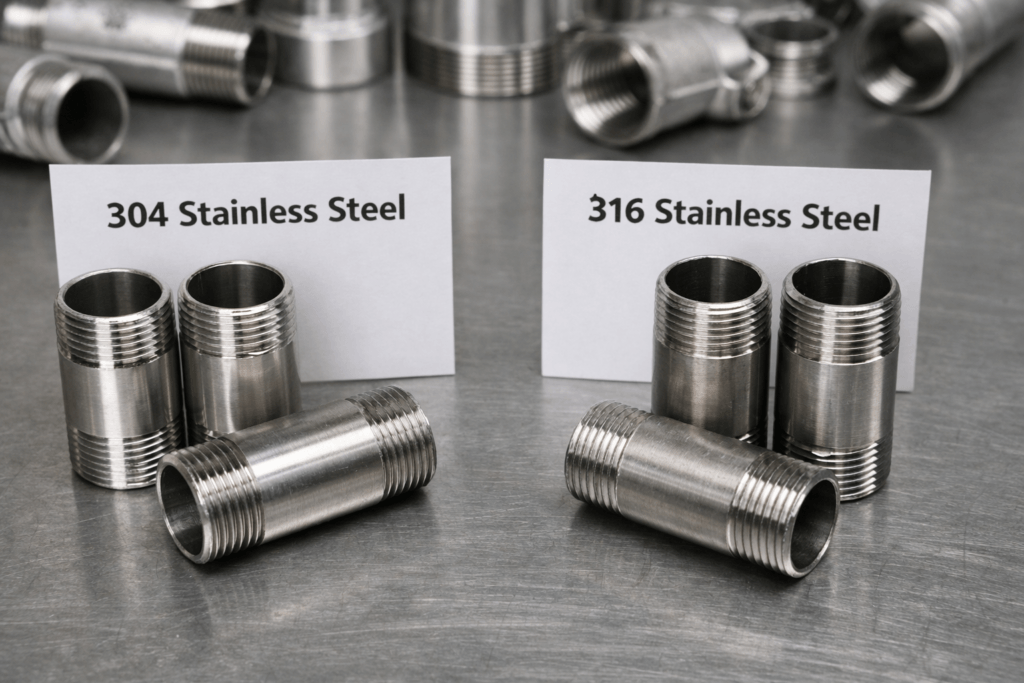
304 is the classic 18-8 stainless steel. Outokumpu describes 304 as roughly 18% chromium and 8% nickel, and calls it the standard all-purpose austenitic grade. 316 belongs to the Cr-Ni-Mo family. That means it adds molybdenum, usually around 2–3%, and its nickel level is also usually higher, around 10–13%.
That extra molybdenum is the big deal. It’s one reason 316 resists corrosion better in harder service. It’s also one reason the material costs more. So, no, the premium is not random. You are paying for a different alloy system, not just a new stamp on the carton.
Alloy surcharge and raw material volatility
There’s another layer buyers feel every month: alloy surcharge.
In stainless supply, the mill price is not only the base price. Producers and distributors often add a surcharge to reflect swings in raw materials. Rolled Alloys explains that this surcharge exists to offset the rise and fall of alloy input costs. It also notes that elements like nickel and molybdenum move the needle. So when those markets jump, 316 tends to move more than 304. That’s why the price spread is often a band, not a fixed rule.
So when people say “316 is 20-25% more expensive,” treat that as a common market shorthand, not a forever number carved in stone. Product form, size, finish, thread type, order volume, and raw material timing all push it around.
304 vs 316 stainless steel price comparison
Here’s the practical breakdown.
| Factor | 304 stainless steel | 316 stainless steel | Why buyers care |
|---|---|---|---|
| Main alloy family | Cr-Ni | Cr-Ni-Mo | 316 has added molybdenum |
| Typical nickel level | Around 8% | Around 10–13% | Higher nickel often means higher cost |
| Molybdenum | None in standard 304 | Around 2–3% | Better chloride resistance, higher alloy cost |
| Price behavior | More stable in mild markets | More sensitive to alloy swings | Purchasing budgets can move faster |
| Best fit | General indoor or mild service | Chlorides, washdown, marine, chemical, harsher duty | Helps avoid wrong-grade claims |
This comparison is based on technical descriptions from Outokumpu and surcharge guidance from Rolled Alloys.
316 stainless steel corrosion resistance in chloride environments
This is where 316 starts earning its keep.
Pitting corrosion and crevice corrosion
In the field, stainless failures often don’t look dramatic at first. You may just see tiny pin spots, brown marks near threads, staining around tight joints, or rough patches inside a wet service line. But those are often early signs of pitting corrosion or crevice corrosion.
Outokumpu’s corrosion guidance says resistance to pitting and crevice corrosion improves as chromium, molybdenum, and nitrogen go up, while nickel helps reduce pitting spread and supports re-passivation. In plain English: 316 handles chloride attack better because its alloy package is built for that fight.
For threaded fittings, that matters a lot. Threads create crevices by nature. Add moisture, chlorides, trapped residue, bad drainage, or aggressive cleaning chemicals, and you’ve got a real corrosion setup. This is why buyers in this sector should never look at flat-sheet data only. A threaded nipple and a smooth decorative panel do not live the same life.
Chloride ions are the real troublemaker
World Stainless says the chloride content of water is the most influential factor when selecting stainless steels in water service. The same guide states that 304 is generally satisfactory below about 200 mg/L chlorides, becomes only marginal in the 200–1000 mg/L range, and that 316 is preferred for critical applications when chlorides go above about 200 mg/L. The Nickel Institute also says chloride content is often the critical factor when corrosion shows up in natural waters.
That lines up with what buyers already see on jobs:
- coastal air and salt spray
- water treatment skids
- food lines with salty or acidic washdown
- chemical dosing packages
- marine service
- wet utility rooms with trapped moisture
- aggressive cleaning cycles around threaded joints
In those scenes, 316 is not overkill. It is often the safer spec.
304 vs 316 stainless steel applications
The right grade depends on the service scene, not on ego.
When 316 stainless steel is worth it
Use 316 when corrosion failure creates real business pain.
| Service scene | Why 316 makes sense | Typical buyer pain point |
|---|---|---|
| Coastal and marine exposure | Better resistance to salt-driven pitting | Early rust claims, ugly surface staining |
| Water treatment and wastewater | Better fit for chloride-bearing water | Maintenance burden, premature swaps |
| Chemical and process piping | Better resistance in harder media | Shutdown risk, spec failure |
| Food processing and washdown lines | Handles repeated wet cleaning better | Hygiene risk, finish breakdown |
| Critical threaded assemblies | Better margin at crevices and roots | Leak path, seized threads, callback |
This table follows guidance from World Stainless, the Nickel Institute, and Outokumpu on chloride service and corrosion behavior.
If your jobsite has chlorides, wet-dry cycling, or a nasty washdown routine, 316 usually buys you time, stability, and fewer headaches. For procurement teams, that means less rework. For distributors, it means fewer complaint emails. For exporters, it means less chance the container lands and the buyer says the material was wrong for service.
When 304 stainless steel is enough
Now the other side. Not every job needs 316.
304 usually works well for indoor service, mild environments, general mechanical use, and places where chloride exposure stays low. If the system is dry most of the time, cleaned gently, and not near salt or harsh chemicals, 304 often does the job very well. Outokumpu describes it as the classic all-purpose grade for a reason.
For many standard stainless steel pipe nipples, welded threaded fittings, or light-duty utility connections, 304 keeps cost under control without creating future trouble. That is often the right call. Not cheaping out. Just right-sizing the spec.
Stainless steel pipe nipples and threaded fittings
For your website, this is the section that speaks directly to the buyer.
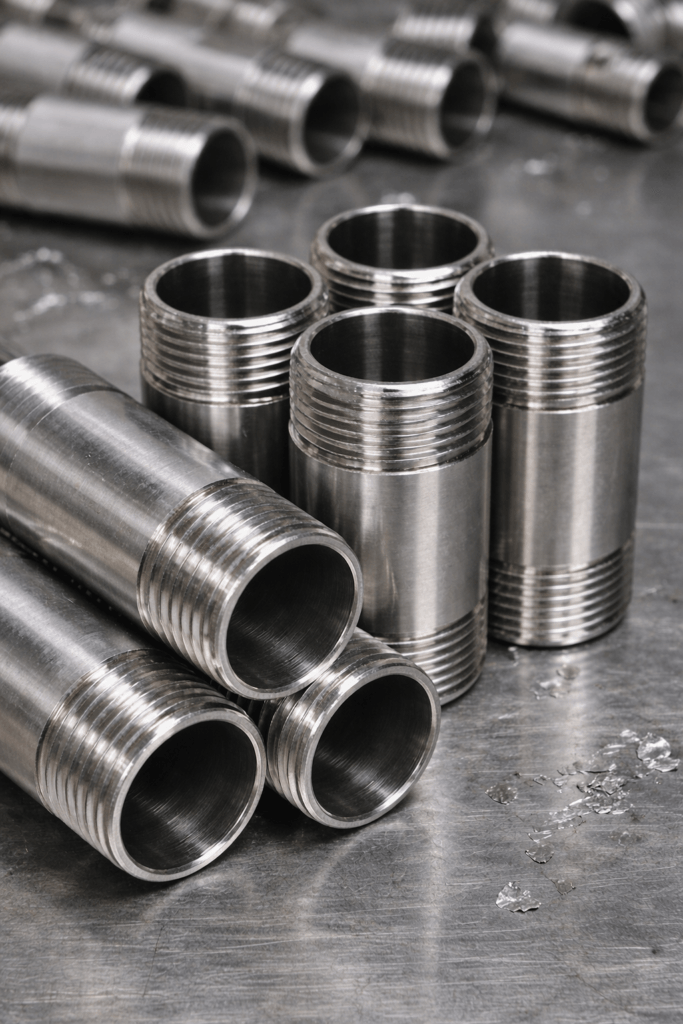
Jingcheng Hardware offers stainless steel pipe nipples, king nipples, seamless threaded pipe fittings, welded threaded pipe fittings, and custom thread options including NPT, BSPT, and BSPP. It also highlights pickled and passivated finishes, custom lengths, and documentation support like 3.1 MTR. Those details matter because material grade alone won’t save a bad fitting package.
316 stainless steel pipe nipples for NPT and BSPT threaded systems
If you are sourcing 316 stainless steel pipe nipples for process lines or corrosive duty, the value is not only the metal. It is the whole package:
- cleaner thread form
- better consistency lot to lot
- passivation support
- traceability
- right thread standard for the market
- OEM marking and packaging for wholesale buyers
That is where GuoCao can be mentioned in a natural way: buyers don’t only want a low unit price. They want less spec drift, fewer thread mismatch claims, and smoother repeat orders. That’s the real commercial value. If GuoCao is part of your sourcing or brand story, position it around supply stability and custom execution, not around empty slogans.
Seamless threaded pipe fittings vs welded threaded pipe fittings
Your site also sells both seamless and welded threaded fittings. That is useful in this topic.
For harsh service, many buyers lean toward seamless threaded pipe fittings because they want higher integrity and fewer concerns around weld areas in demanding duty. For standard service, welded threaded pipe fittings can be the more cost-aware choice. Jingcheng Hardware frames seamless fittings as suitable for demanding service and welded fittings as cost-effective for standard use. That is a solid way to guide buyers without overselling.
Stainless steel material selection checklist
Before you choose 304 or 316, ask these questions.
| Checklist item | Why it matters |
|---|---|
| Is there chloride exposure? | This is often the first filter for 304 vs 316 |
| Is the fitting threaded? | Threads create crevice risk |
| Is the service indoor, coastal, washdown, or chemical? | Environment drives corrosion speed |
| Do you need NPT, BSPT, or BSPP? | Wrong threads kill installs fast |
| Do you need MTR and traceability? | Required in many QA, EPC, and export jobs |
| Seamless or welded? | Service level and budget both matter |
| OEM/ODM or private label? | Helps distributors and chain buyers scale cleanly |
| Bulk wholesale or mixed custom lengths? | Impacts lead time and stock planning |
This checklist reflects the technical guidance above and the capabilities shown on Jingcheng Hardware’s product pages and homepage.
Is 316 stainless steel worth the premium?
Most of the time, the answer is not “always” and not “never.”
If your project runs in a mild indoor scene, with low chloride exposure and normal service conditions, 304 is often the smarter buy. It keeps cost lower and still gives you the corrosion resistance most general jobs need.
If your project lives around salt, wet cycles, chemicals, washdown, or critical threaded joints, 316 is usually worth the premium. You are paying more up front, yes, but you are buying a better buffer against pitting, crevice attack, maintenance load, and ugly field failures.
And for wholesale buyers, EPC teams, machinery makers, and distributors, that’s the bottom line: the right grade is the one that keeps the job moving and keeps the claim file quiet. In real projects, that matters more than chasing the lowest quote on day one. Cheap on paper can get expensive real quick.
If you want, I can turn this into a fully optimized blog post format for your site, with SEO title, meta description, slug, FAQ schema questions, and internal anchor text suggestions for your Stainless Steel Pipe Nipples and King Nipples pages.